AI & Technology · March 26, 2026 · 5 min read
Pharma's $1 Billion Bet on AI Drug Discovery: What the Numbers Actually Say
Q1 2026 saw a surge in pharma-AI partnerships:
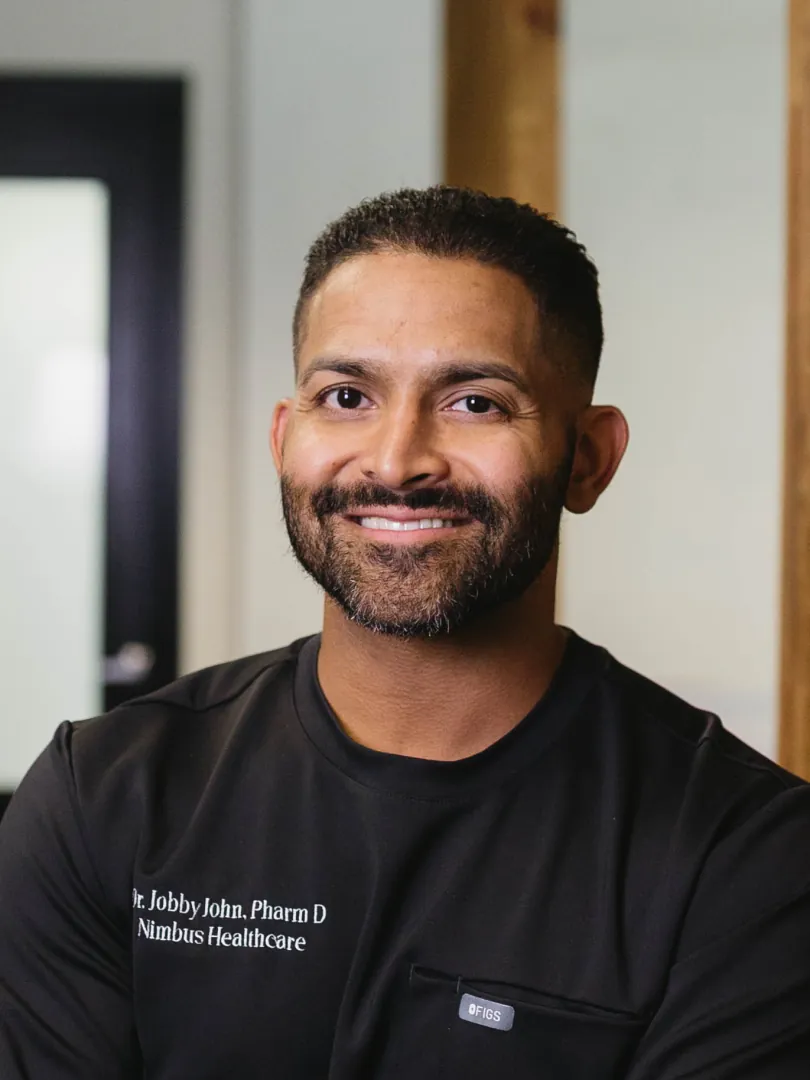
Dr. Jobby John, PharmD, FACAPharmacist and Founder & CEO, Nimbus Healthcare
AI & Technology · March 26, 2026 · 5 min read
Q1 2026 saw a surge in pharma-AI partnerships:
Q1 2026 saw a surge in pharma-AI partnerships:
The headline total exceeds $1 billion for the quarter. It sounds like a watershed moment.
But look at the deal structures. The Recursion partnership has a $20M upfront payment with $280M in development and commercial milestones. Isomorphic's $500M deal has a $45M upfront with the rest contingent on clinical success across multiple programs.
The average upfront commitment across these deals is $15-25M. That is a rounding error on a major pharma company's R&D budget. The billion-dollar headlines come from theoretical milestone totals that assume everything works.
Pharma is buying options, not making bets. And that distinction matters for understanding where AI drug discovery actually stands.
The bullish read: Pharma companies are diversifying their discovery pipelines by adding AI-derived candidates alongside traditional approaches. Even if only 10% of these partnerships produce clinical candidates, the cost-per-candidate is lower than traditional high-throughput screening.
The bearish read: These deals are hedge bets. Pharma companies are spending the equivalent of their annual holiday party budget to ensure they do not miss the next wave. The real R&D budgets remain overwhelmingly committed to traditional approaches.
My read: Both are true, and the tension between them is exactly where the opportunity lives.
AI drug discovery is not replacing the traditional process. It is compressing specific bottlenecks within it. Compound screening that took 18 months can now take 3 months. Target identification that required years of wet lab work can be narrowed to months with computational predictions. But clinical trials still take years. Regulatory review still takes years. Manufacturing scale-up still takes years.
The companies that understand which parts of the pipeline AI can compress, and which parts it cannot, are the ones making smart investments.
1. The real value is in failure reduction, not speed. The most impactful AI drug discovery applications are not finding new drugs faster. They are killing bad candidates earlier. A compound that fails in Phase II costs $50-100M. An AI system that can predict Phase II failure at the preclinical stage saves that entire investment. The ROI math on "avoided failure" is better than the ROI math on "faster discovery."
2. Internal AI teams matter more than external partnerships. The pharma companies building the most durable AI capabilities are not the ones signing the biggest partnership deals. They are the ones hiring computational biologists, building internal data platforms, and integrating AI into their existing R&D workflows. Partnerships are supplements, not substitutes.
3. Data quality is the actual bottleneck. Every AI drug discovery company pitches their model architecture. Nobody pitches their data curation pipeline. But the model is only as good as the training data, and biological data is noisy, incomplete, and inconsistently formatted across institutions. The companies investing in data infrastructure, not just model infrastructure, will outperform.
I have spent my career in the part of healthcare that sits between the drug and the patient. Here is what that perspective tells me about AI drug discovery:
The drug pipeline's biggest problem is not that we cannot find candidates. It is that too many candidates fail late. Every Phase III failure represents years of work, billions of dollars, and, most importantly, patients who enrolled in trials for drugs that did not work.
If AI can shift even 10% of late-stage failures to early-stage kills, the impact on patients is enormous. Not because they get new drugs faster, but because clinical trial resources get redirected to candidates more likely to succeed. More shots on goal, better aim.
That is not a $1 billion opportunity. It is a $100 billion reallocation of the global R&D budget toward higher-probability programs.
Technology partners




NVIDIA, the NVIDIA logo, and NVIDIA Inception are trademarks and/or registered trademarks of NVIDIA Corporation in the U.S. and other countries. Twilio and all related logos are trademarks of Twilio Inc. Other names are trademarks of their respective owners. Membership and platform use do not constitute endorsement.